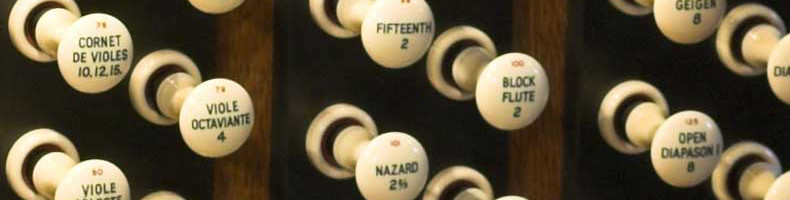
The 1859 Bryceson organ in St Dominic's Priory
'A story of homecoming' by Martin Stacey
This is how an historic 1859 Bryceson organ was saved from an uncertain future and re-housed in St Dominic's Priory, only a few miles from where it was built. During the spring of 2005 it came to my attention that the parish council of Old Cleeve, in Somerset (United Kingdom), had decided to replace the historic organ in their church with an electronic instrument.
Enquiries
I made enquiries to the vicar and church wardens in Old Cleeve, who informed me that there were several factors which gave rise to this decision being taken:
- Health and safety issues had arisen due to the organ being located in front of the vestry door, making access very difficult and posing a fire risk.
- The blower to the instrument was frequently affecting the local electricity supply, blowing fuses and short circuiting the entire church.
- Redevelopment of the chancel area was needed and the position of the organ was unsuitable.
- The limitations of the instrument were preventing the music in the parish from developing in the way they desired.
Their intention was to dispose of the instrument, as no other alternative seemed possible. Having visited the instrument myself, and finding it to be in very good working order with a fine sound and beautiful appearance, I felt it was necessary to try to save the organ. I persuaded the vicar to postpone any action until I had consulted the Brethren of St Dominic’s Priory (where I work in London) and the Deane Organ Builders (who previously maintained the instrument) to find out whether a new home for it could be found at not too great an expense.
The Deane Organ Builders gave an initial quote of £3250 for the removal, restoration and relocation of the organ in London. This did not seem unreasonable.
Agreements
The Brethren of St Dominic’s Priory met in Chapter and agreed that the addition of a small organ in the Lady Chapel would benefit the local community in many ways, and that it was prepared to house the instrument as I had funds available for work to commence.
A faculty was obtained to allow the organ to be removed from its home in Somerset, and it was finally taken out of the church shortly before Christmas 2005 and stored at the Deane Organ Builder’s workshop in Taunton.
History revealed
During the dismantling process, an old delivery-note was discovered perfectly preserved inside the swell-box. It stated that the organ had been sent by Great Western Railway to Watchet in Somerset, from 34 Brook Street, Euston Road (London) where Bryceson had their factory from 1859 to 1867. The organ would be “coming home”, since St Dominic’s Priory is situated just a few miles north of where it was built. More significantly, it dates precisely with the time construction was begun on the Priory building and matches exactly the design and colour-scheme of the interior.
Specification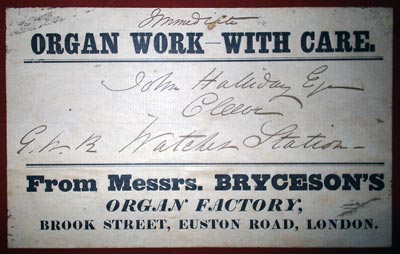
Bourdon 16 (bottom octave only)
Open Diapason 8’
Stopped Diapason 8’
Dulciana 8’
Principal 4’
Compass: CC-f
Mechanical action throughout
Pedal-board attachment (added in 1974)
Folding cover
Draw-stops above keyboard
All speaking pipes enclosed in a balanced swell box
Delays
The Deane Organ Builders were unable to attend to the instrument immediately due to their demanding work schedule. At first, this was not a problem, as the main concern had been to preserve the organ and there was no rush to reinstall it. When the time came to begin cleaning the instrument, however, it was noticed that there was a certain amount of asbestos in the old blower, that the draw stop mechanism had been chewed by mice, and that the keyboard needed re-bushing. The last two faults were not necessary to remedy at once, but the blower needed immediate attention.
A complete proposal was written and submitted to St Dominic’s Priory at the end of 2006 detailing the work needing to be done and a break-down of costs was given. The final figure amounted to £5550. It was necessary to put the proposal to the Dominican Chapter, in light of these costs, and it was (understandably) not possible for the church to provide any money. Given that the Priory had spent several hundreds of thousands of pounds restoring the church roof during 2006, and since the budget for 2007 had already been set, they did not feel able to justify the expense. It was explained that this decision was purely financial and that, should alternative methods of funding be found, they would still gladly provide a home for it in the Lady Chapel.
The solution
Brian Verrier and Colin Brice (the Deane Organ Builders) generously agreed to replace the blower with a new, smaller one and deliver it to St Dominic’s Priory for the original estimate of £3250 (given that their delay was responsible for the situation) and allowed me to pay the extra amount when ever possible.
The Bryceson Organ Appeal
I contacted all the major grants organisations in the UK but was not able to apply for funding in the normal way, because this was not a normal situation. The future of the instrument was under threat, and there was no time to wait another three to six months for awards to be made (if they were even accepted). I was disturbed to hear a senior figure in the UK’s most important conservation organisation dismiss the project as “too specialist” and refusing to help – although he did wish me luck! If the money needed was not raised, the cost would have escalated beyond reasonable means, and the 1859 Bryceson organ would have been added to the countless others which have been lost over the years. The fact that an instrument is small should not make a difference to its importance. One day, another organ like this will be the last remaining one of its kind, and only then will national support be more easily forthcoming. Organists everywhere keep saying how sad it is that organs are being replaced by electronic instruments, and that the craftsmanship of historic builders will never be recreated, so the Bryceson Organ Appeal offered people the chance to make a difference by helping to save one.
The appeal was launched in February 2007 and soon had received £2,055 in donations from private sponsors and fund-raising concerts. A further £1,000 was generously donated by the Bernarr Rainbow Trust. However, a significant amount still needs to be raised to complete the project, which includes the basic removal work, purchase and installation of a new blower, and repair work to the key-action and stop-mechanism.
Coming home
From the 16th June 2007, the Deane Organ Builders spent three days reconstructing the organ in the Lady Chapel of St Dominic’s Priory. It now begins the next phase of its life, sounding better than it has ever done before in a spacious acoustic and beautiful setting. It will be used every month in the regular organ recitals and contribute to a wealth of musical activity in the years ahead.
All are welcome to view and play the organ (by arrangement) and my sincerest thanks go to all those who have contributed to saving this fine instrument.
Martin Stacey, Summer 2007